Check one
Is it any good, here
Judged against the city it is in and the thing you would come to it for, by reading local writers rather than counting stars. A famous place that is coasting gets left out.
The method
Every place in a guide is checked on four things before a family sees it. A place that fails any of the four does not go in.
 Kate Sinha, founderUpdated 31 August 20267 min read
Check one
Judged against the city it is in and the thing you would come to it for, by reading local writers rather than counting stars. A famous place that is coasting gets left out.
Check two
Against the days of your actual trip, on the venue's own page, in the local language where that is where the closures are posted. Not against a general week.
Check three
Timed from the door of where you are sleeping, at the hour you would leave, including the car park and the walk from it. Not from a pin in the city centre.
Check four
Weighed against your children's ages, the pace the group moves at and what the weather is doing. A beach with no shade is fine at four and unusable at noon.
Most travel advice stops at the first one. A blog says a restaurant is wonderful, and it was, in June, for two adults without a pushchair. The gap between that and a Tuesday in February with a toddler who naps at one is where family trips go wrong.
The four are ordered by what each catches. Check one decides whether a place is worth anyone's morning. Check two is the one that saves mornings: five closed venues were caught this way in a single guide. Check three is where plans quietly fall apart, because a twelve minute walk and a twelve minute walk uphill in August with a pushchair are the same number and a different day. Check four is what makes a place belong to your family rather than to a list.
The long version of check two, in four steps you can follow yourself, is below. The ten things worth checking before any family trip are on the blog.
This is the most valuable five minutes in trip planning and it is almost always done halfway. Most people read the hours on a map listing, see a green "open", and move on. That listing can be right about the week and wrong about your day.
Four steps, in this order, because each one catches something the step before it cannot.
Map listings, review sites and booking platforms all carry hours, and all of them are copies. They update when somebody remembers, and a small restaurant that changed its closing day in March may not have told any of them.
Find the place's own website, or failing that its own social account, which small venues often update long before anything else. If the two disagree, the venue is right. This is not a rare edge case. It is the normal condition of the internet in a town where somebody is running a kitchen rather than a web page.
This is the step people skip, and it is where the expensive answers hide.
Annual closures, holiday weeks, seasonal changes and "shut for a refit until the eighteenth" are posted once, on the local-language version of the site, in the language of whoever wrote it. English pages on the same site are usually older and rarely carry the notice. Open the local version, let the browser translate it, and read the part that looks like an announcement.
A lunch spot that appears first on every list for one of the cruise ports we researched had closed permanently. Every article still recommended it. Its own page said so on the first line.
"Open Tuesday to Sunday" is a pattern. Your trip happens on dates. Find the calendar, the opening times page or the booking widget, and look at the day you are going.
Public holidays, school terms and local festivals move opening hours in both directions, and a national holiday in the country you are visiting will not appear in your own calendar. Check whether your dates sit on or beside one, then re-read step three for anything that matters, because holiday hours are published as an exception rather than as a change to the normal pattern.
Sometimes there is no site, no calendar and no post since last year. Three honest options, and the third is the one we take:
About five minutes a place once you have done a few, and less for anything with a proper booking system. For a week with two or three things a day, that is an evening. It is the difference between a plan and a plan that survives contact with the week.
Two things worth doing while you spend it. Start with the anchors, the two or three things you would be genuinely sorry to miss, because if one of those is shut you want to know while the rest of the trip can still move. And write down where you checked and the date you checked it, so that when somebody asks on the morning you can look again in ten seconds instead of starting over.
The checking is what makes a guide worth paying for. It is not where the work begins.
Modern research tools, including AI, are used to search wide. Nothing ships on that basis alone. Every place is verified against a live source afterwards, and a person reads the whole shortlist against what the family wrote before anything is built. The failures you have seen from travel chatbots, the closed restaurants and the invented places, are the exact thing this step exists to catch.
Places close without warning and no amount of checking prevents that. What the method does is make sure you are never the last to know: a guide is built within a day of being asked for, so its checks are as fresh as they can be, and every place carries the source behind it so you can confirm anything on the morning it matters.
It is also not a booking service. Nothing is reserved on your behalf, and no commission is taken from any venue, hotel or operator, which is why nothing appears in a guide because somebody paid to put it there.
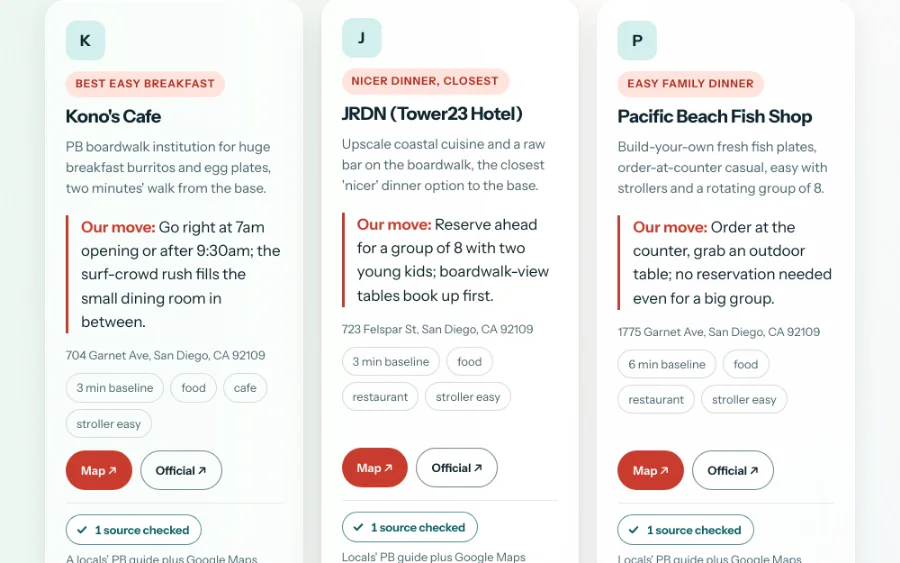
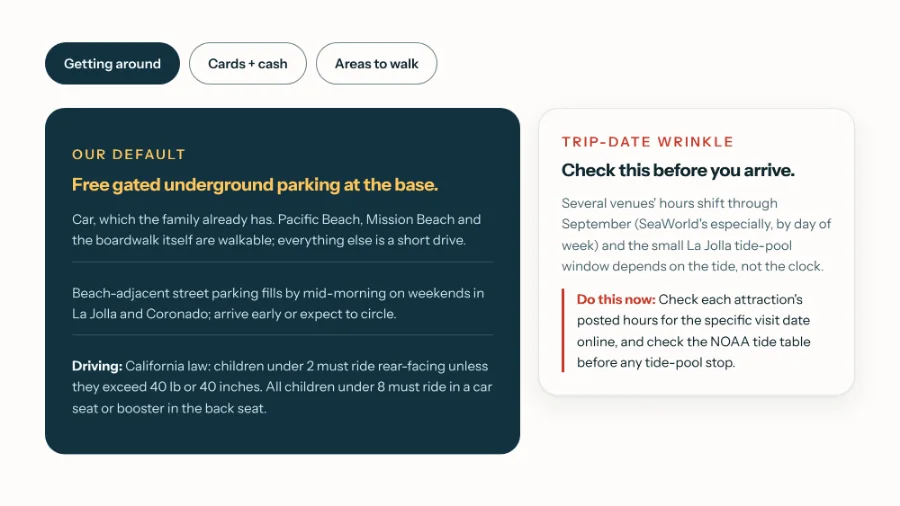
Open the San Diego guide, built for three generations over ten days and anonymised. Tap into any place and you can see what it was checked against. More questions are answered on the questions page, and the alternatives to having this done for you are compared here.
Guides are $99, $179 or $299, depending on how many places you are staying. See the three tiers.