Method
Planning a day around a nap that has not happened yet
Most holiday plans for families with a toddler are written as if the day has ten usable hours in it. It has about six, in two pieces, and the join between them is not negotiable.
 Kate Sinha, founderUpdated 12 August 20265 min read
The nap is the fixed point, and everything else moves
The usual approach is to plan the day and then work out where the nap goes. It never fits, so it gets shortened, and then the afternoon belongs to a child who is neither asleep nor coping.
Turn it round. Put the nap on the day first, at the time it happens at home, and treat it as the appointment that cannot move. What is left is a morning of about three hours and an afternoon of about three, and you plan into those. A day built this way looks emptier on paper and works considerably better.
One outing a side, and one of them is small
Two real things a day is the ceiling with a napping child, and that is optimistic if either involves a drive. What holds is one proper outing and one small thing: a morning at the aquarium, an afternoon at the playground near the flat.
The reason is not stamina, it is transitions. Every leaving, fastening, folding and parking costs about twenty minutes and a little of everyone's patience, and a day with four of them in it is a day about logistics.
Protect the hour before dinner, not the middle of the day
Between five and six is where a family day is usually lost. Everybody is tired, nobody has eaten since two, the interesting thing is over, and dinner is an hour away. Plan for that hour deliberately: somewhere to be that costs nothing, near where you are sleeping, with food available earlier than you think you need it.
In much of southern Europe this collides with kitchens being shut until seven, which is worth knowing before the afternoon it happens. It is one of the ten things worth checking.
Decide in advance which naps happen on the move
Some children sleep in a pushchair or a car seat and some do not, and the honest answer for your child is usually known by the second day of any trip. It changes the shape of the week:
- If they sleep on the move, put the drive in the nap. Ninety minutes during a sleep is free time. The same drive at four in the afternoon is the worst hour of the trip.
- If they only sleep in a bed, accept a return to the accommodation every day and choose things within about twenty minutes of it. A trip planned around a base you go back to is the design, not a compromise.
- If it depends, plan for the bed and take the pushchair sleep as a bonus. The other way round produces a two hour drive with a screaming child in it.
Heat changes the shape, not just the comfort
In a hot climate the usable day splits into early morning and evening, and the middle belongs to shade and water. That lines up almost exactly with the nap: out at eight, back before eleven, sleep through the worst of it, out again at four. It is the local pattern for a reason, and families who fight it spend the week hot and disappointed.
What to check is what is open at eight in the morning and at seven in the evening, which is a different list from the middle of the day.
The day the nap does not come
It will happen, usually on the second or third day, usually after a big morning. The day is not ruined, but it is over as a plan. What helps is deciding in advance what you do instead, so nobody has to think:
- Move the second outing to tomorrow rather than pushing through it. Nothing on a holiday is worth the afternoon it costs.
- Have one nearby thing that needs no booking, no tickets and no driving. A park, a pool, a beach, the flat.
- Eat earlier than planned. Most late-afternoon collapses are half hunger.
- Let the day be early. Everyone in bed at seven buys back tomorrow.
A week with two days like that in it is a normal week. A plan with no room for them is what turns them into a problem.
What this looks like written down
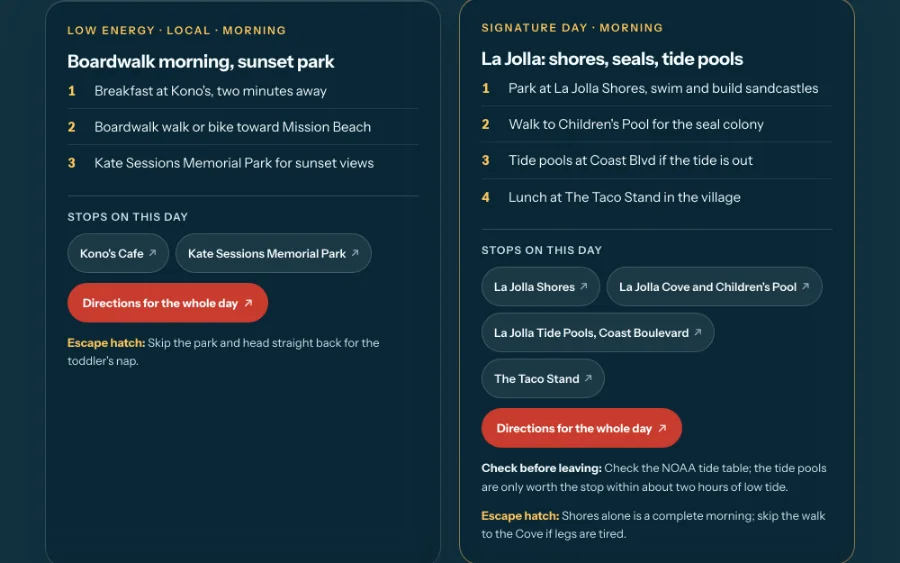
It is why the day plans in a guide are short, why every timing is attached to your own accommodation rather than to a city centre, and why each day carries an escape hatch decided before the trip rather than at four in the afternoon. A plan with four things in it is not worth more than a plan with two. It is a plan somebody will have to abandon.
The four checks covers the rest of the method, and all of it is free to copy.
Or have the week built this way for you
The questionnaire asks about nap rhythm, ages and what trips up your days, and the plans get built around the answers. Guides are $99, $179 or $299 depending on how many places you are staying. See the three tiers.