Almost every family booking Amsterdam picks a hotel by how close it is to the middle. That is the wrong thing to optimise. The city is small enough that the distance barely matters, and what you are choosing is which neighbourhood you want to live in for a week.
Kate Sinha, founderUpdated 2 September 20269 min read
Places checked 1 September 2026
Almost everyone books the centre
Search for a family hotel in Amsterdam and you get the canal belt: walking distance to Dam Square, a few minutes from Centraal, a picture of a gable. It is the obvious choice, and with a toddler it costs you more than it gives.
Centrum has the queues, the highest prices and the most crowded pavements in the city. It also holds the oldest housing stock, which turns out to matter more than the address does. The residential rings around it have the good bakeries, the working markets, the playgrounds and the parks, and they are all fifteen to twenty-five minutes from the middle by tram.
The city is smaller than the map makes it look
Amsterdam is flat. Not mostly flat, flat. There is no hill anywhere in your week, which changes what a walk costs when you are pushing one child and negotiating with another. Half an hour on foot here is a pleasant way to get somewhere, which is not true in a hill town of the same size.
So the question is not how far you are from the middle. It is which neighbourhood you want to be a resident of for a week.
The one thing worth checking on a map before you book is whether the address is on a tram line. If it is, it is close enough, and you can stop optimising.
The five areas, and what each is for
01
Oud-West and De Baarsjes
Residential west. The best everyday food in the city
The best default for a family with young children. Ten Katemarkt, De Hallen and the Kinkerstraat coffee cluster are the same five minutes apart, so a morning chains together without any travel between stops, and Westerpark, Rembrandtpark and Erasmuspark are all close. Fifteen to twenty minutes to the museums.
Vondelpark and the museums, quieter and more expensive
The right choice if the trip is built around the big museums. Museumplein sits on the corner of Vondelpark, so the museums and the park are a single outing. Calmer and greener than the centre, and priced accordingly.
Underrated with small children. Artis is here, so is the Scheepvaartmuseum, and the parks are the least crowded of any ring. A good pick for a second visit or a family that wants a slow week.
More space for the money, and the ferry from behind Centraal is free, runs constantly and is a small outing in itself rather than a commute. The trade is that every trip into the rest of the city starts with a crossing, which is charming twice a day and tiring four times.
The canal belt and the station. The default, and the hardest
Think twice. The pavements are the narrowest in the city, the queues and the prices are the highest, and it holds the oldest housing, which is where the staircase problem below is worst. Worth a morning of your trip. Sleeping there with a stroller is a different proposition.
The maps are schematic. They show which part of the city each area sits in, not where its boundaries run.
Ask about the stairs before you book anything
Dutch houses are narrow, and a narrow house has to put its staircase somewhere. The result is stairs that are far steeper and far narrower than most visitors expect, closer to a ladder than to a staircase in the oldest buildings. Lifts are rare in anything that is not modern. In the canal belt and the older parts of the centre and the Jordaan, an apartment two or three flights up with no lift is completely normal and is very often not mentioned in the listing at all.
With a baby, a stroller and a week of luggage, that is four trips up and down every time you leave.
Ask the host directly, in writing, before you book:
How many flights of stairs are there to the apartment?
Is there a lift?
How steep and how wide are the stairs, and is there a handrail?
Is there anywhere on the ground floor to leave a stroller?
Any host used to families will answer these in a sentence. A host who will not answer them has told you something too.
Getting around, and why a car is the wrong instinct
Do not plan around a car. The centre is a low-emission zone, parking is among the most expensive in Europe, and nothing you want to do here needs one.
Trams and metros take strollers as standard and nobody blinks. Tap a contactless card when you board and again when you get off, or buy an OV-chipkaart. The ferries from behind Centraal across the water to Noord are free, run all day, and take strollers and bikes, and they are the cheapest fun you will have with a four-year-old. Anything under fifteen minutes, walk it. The city is flat and walking is usually faster than waiting.
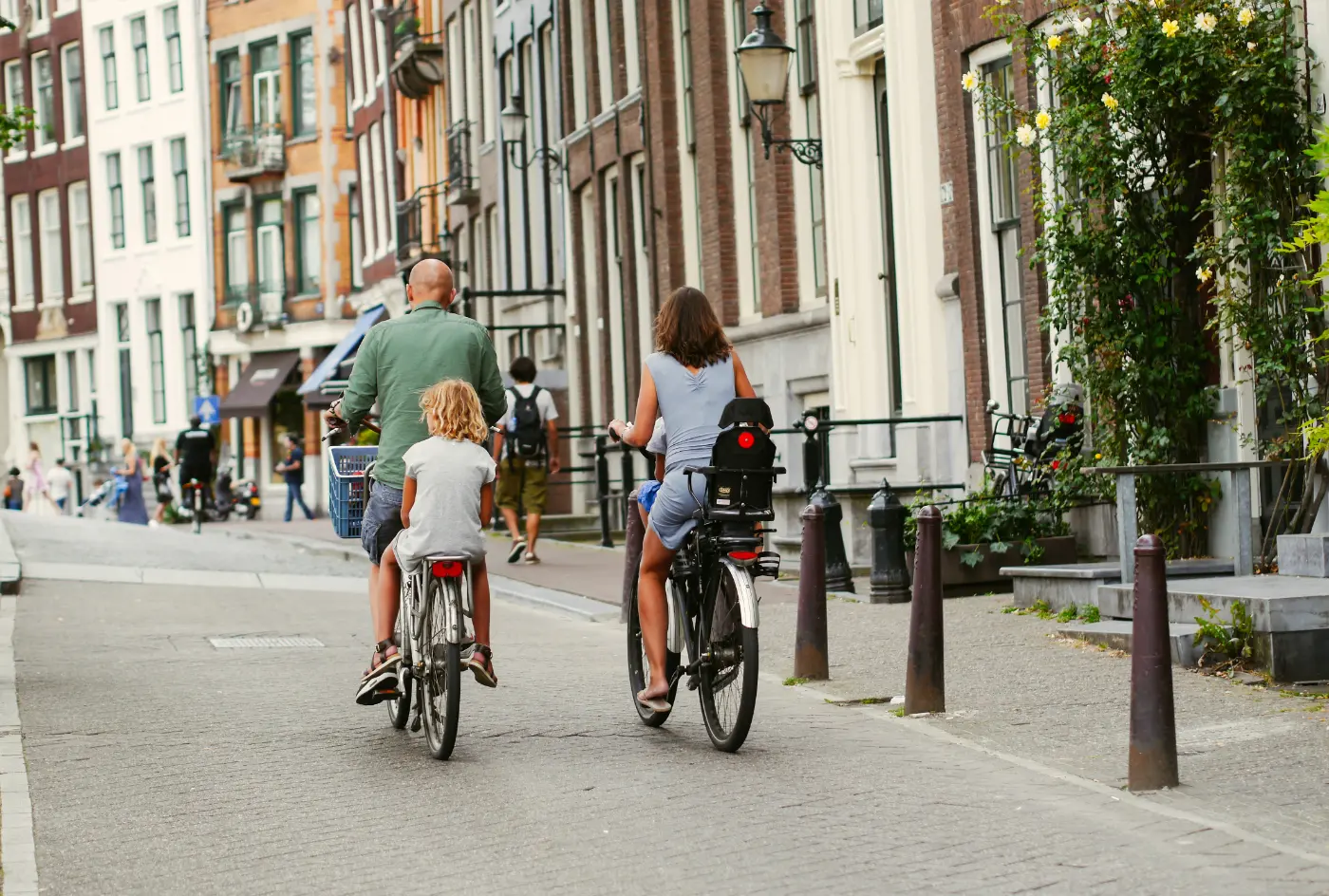
Bikes have right of way and they will not stop for you. Look right before you step off any kerb, every time, and hold onto small children near a bike lane. This is the single most common way visiting families have a bad moment here.
A tram or metro stop within a few minutes' walk. Not which line, just that there is one.
The school holiday dates for your month. Amsterdam follows the regio Noord calendar, and whether the city's own children are on holiday moves how busy every playground, park and family museum is far more than the weather does. We wrote that up separately in Amsterdam school holidays, and the week the city empties out.
Somewhere to put a stroller. In a small apartment this is a real question.
What is on your street. A bakery and a supermarket within two minutes changes a week with small children more than any attraction does.
Where the rest of this lives
This page answers one decision. The free Amsterdam guide covers the whole city: 78 places, where to eat, the playgrounds worth crossing town for, and what to do when it rains all day.
If you want a guide built around your own trip, with every journey timed from the address you booked and every place checked against your dates, that is what we sell. If you would rather do it yourself, the four checks sets out exactly how.
Questions people ask about staying in Amsterdam with children
West, meaning Oud-West and De Baarsjes, for most families. It has the best everyday food in the city, Westerpark, Rembrandtpark and Erasmuspark all within reach, a working six-day market, and a tram ride of fifteen to twenty minutes to the museums. Zuid is the alternative if the trip is built around Vondelpark and the museums, and Oost is the quietest of the three.
Usually not. It is the most crowded and most expensive part of the city, and its housing is the oldest, so it is where steep narrow staircases and no lift are most likely. Everything in the centre is fifteen to twenty-five minutes away from the residential rings by tram, so staying outside it costs you very little.
Yes, with one trade-off. You get more space for the money and the ferry from behind Centraal is free and runs constantly. But every trip into the rest of the city begins with a crossing, and that is a fixed cost on every outing.
They are adjacent. Museumplein sits on the south-east corner of Vondelpark, so the museums and the park are one trip and not two. Families often plan them as separate days and waste one.
No, and you should actively avoid one. The centre is a low-emission zone, parking is among the most expensive in Europe, and nothing a family wants to do here needs a car. Trams, metros and ferries all take strollers.
They can be, and it is the thing least likely to appear in a listing. Dutch houses are narrow, and their staircases are steep and often very narrow as a result. Lifts are rare in anything that is not new. Ask the host directly how many flights there are and whether there is a lift, before you book rather than after.
A guide takes this and rebuilds it around the address you actually booked, your dates and your children's ages, with every journey timed from your own front door. Guides are $99, $179 or $299 depending on how many places you are staying. See the three tiers, or open a real guide first.
Can we use cookies?
Only to see what is working, including our advertising. Nothing here needs
them, and we set none unless you say yes. What we collect.